
To understand the "why" behind misinformation, we conducted a survey (n=45) and background research on Gen Z’s digital behaviours.
1
Convenience trumps verification: While 80% of users believe it is important to critically evaluate content, they rarely leave the app to do so. The scrolling "flow" is sacred.
2
The "Comment Section" Heuristic: 89.4% of users rely on comments and replies as their primary method of verification. They look for social proof rather than objective sources.
3
Echo Chamber Anxiety: Despite their efforts to cross-check (76.6%), 75% of users feel they still suffer from an imbalance of perspectives in their feed.
The solution had to work within the user's existing habits. It could not feel like homework.
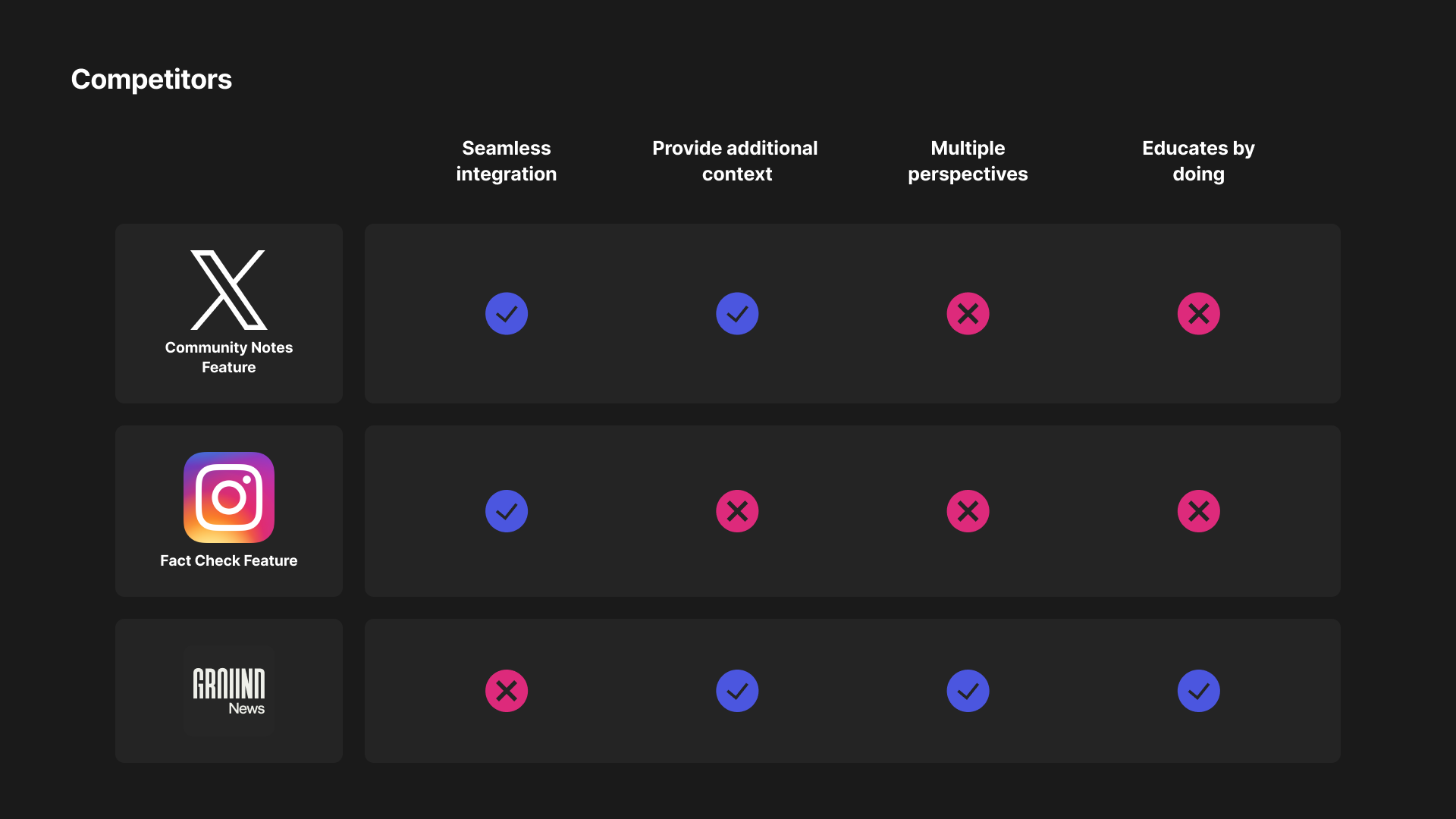
Existing tools force users to choose between convenience and credibility.
Twitter Community Notes
Relies on a single platform with fluctuating trust levels.

Instagram Fact Check
Uses intrusive blocking/warning screens that feel punitive rather than helpful ("scolding" the user).

Ground News
Excellent data, but high friction. Requires leaving the social app to check a separate source.

The Problem
Gen Z seeks seamless online experiences yet struggles to identify credible content due to disruptive fact-checking processes. This leaves them vulnerable to misinformation and skewed perspectives.
The Problem
How might we...
Empower users to view multiple perspectives and gain context within 7 seconds, without leaving their feed?
The Solution
The Solution
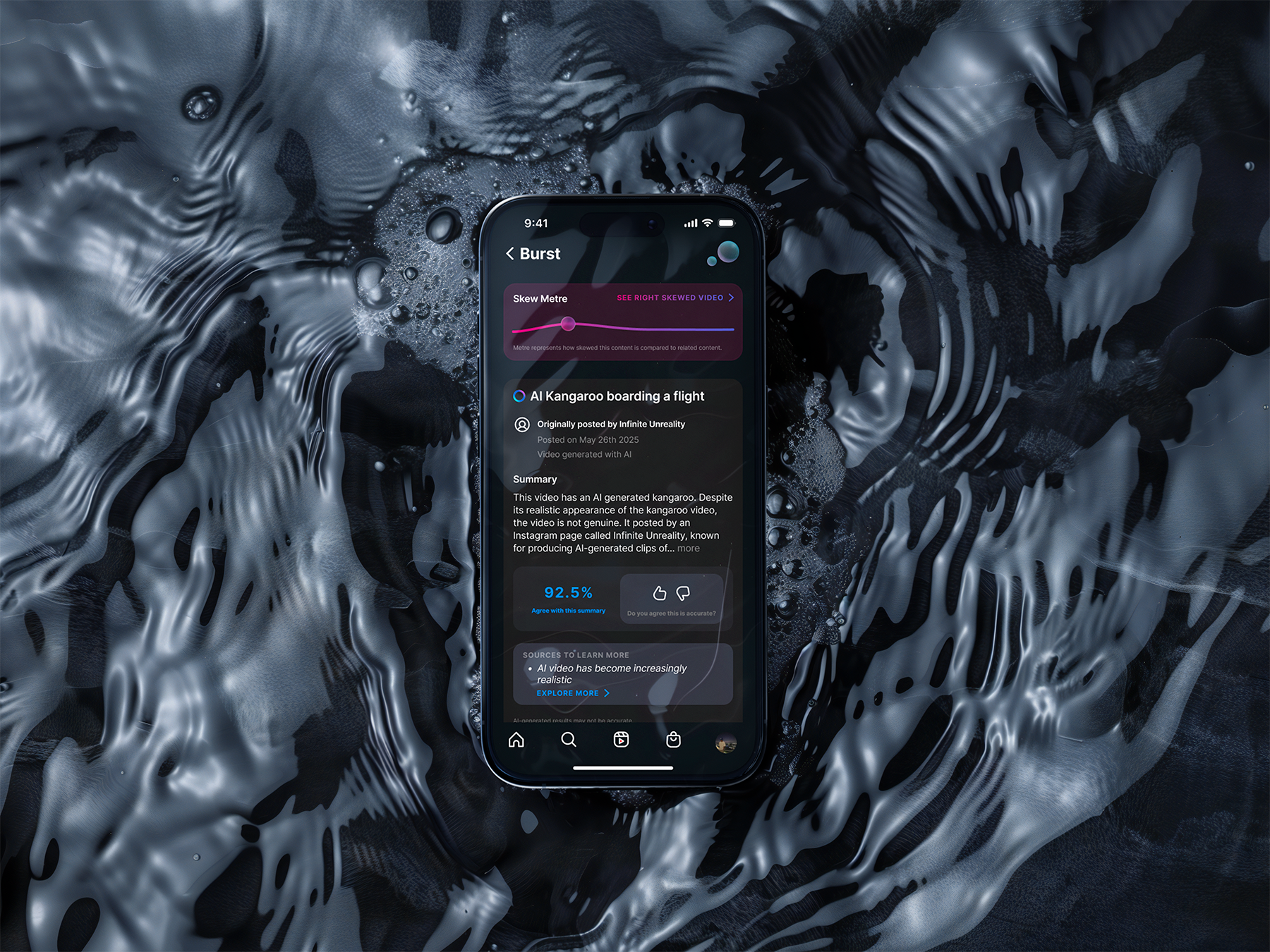
Burst is a seamless overlay that integrates directly into social platforms (starting with Instagram Reels). It provides instant context and verification tools that feel like a natural extension of the interface, not a barrier.
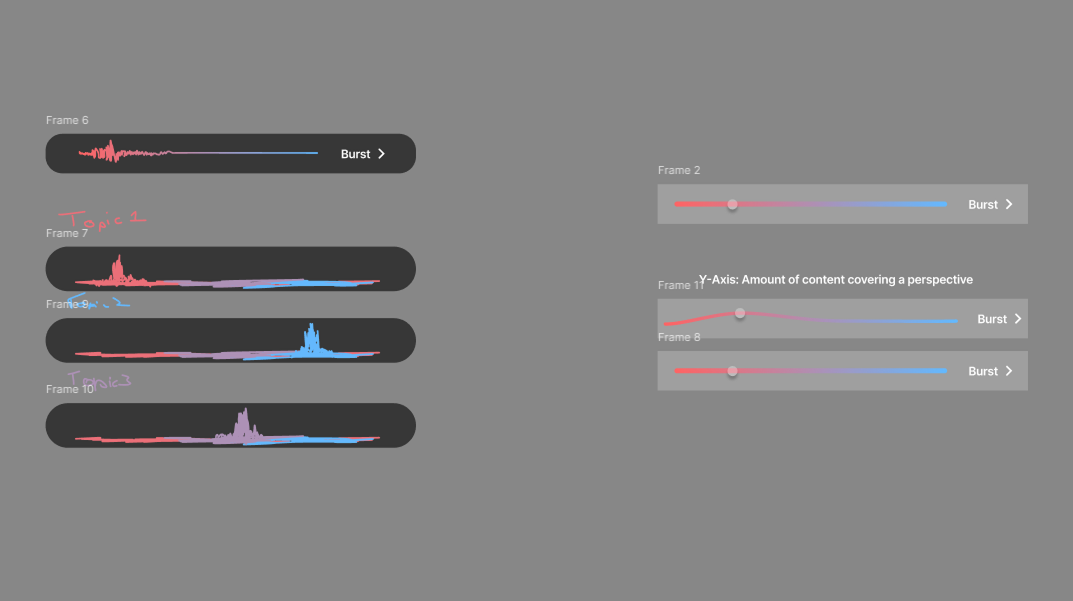
Skew Metre
Assists users to identify how one-sided the content is
Slide to view other perspectives
 to gain more context
to gain more context
- Related videos
- AI summaries validated by users
The Design Process
Competitive Auditing & Gap Analysis
We mapped competitors against four axes. We identified a clear "White Space" for a tool that was both seamless and offered multiple perspectives.
Our persona, "Ryan" (21, Student), views verification as extra effort.

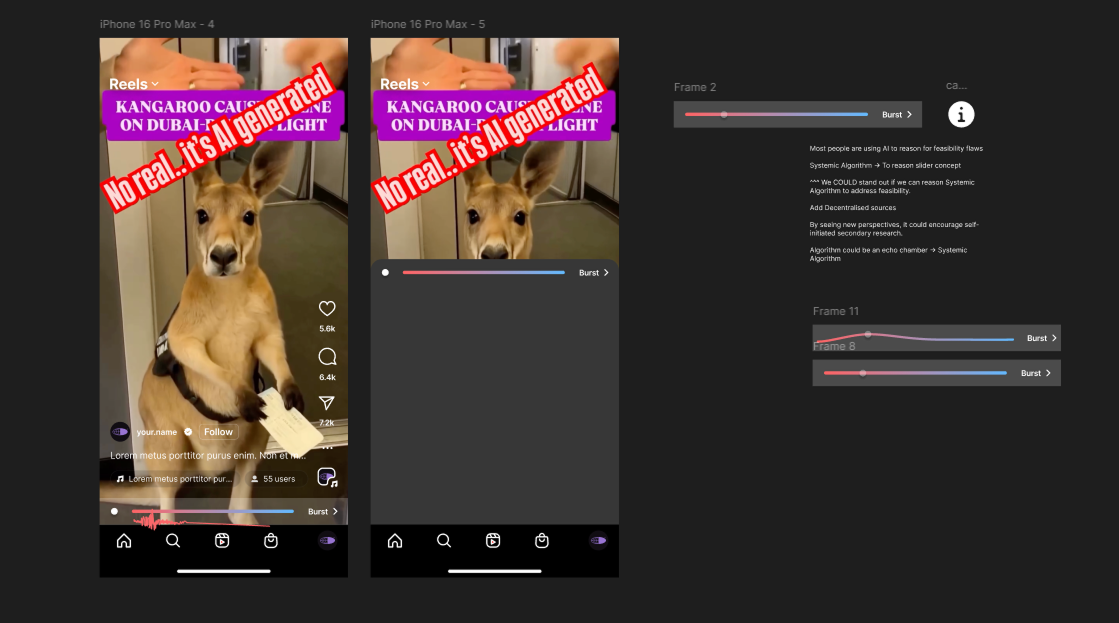
Instead of a pop-up modal, which interrupts flow, we utilised a bottom-sheet overlay. This mimics native UI patterns (like comments), making the interaction feel familiar.
Visualising Bias
We needed to visualise abstract concepts like "bias" and "truth."
We developed the Skew Metre.
Rather than a binary "True/False" flag, we used a gradient slider. This encourages users to see information as a spectrum rather than an absolute, fostering critical thinking rather than just spoon-feeding answers.
System Usability Scale
The participant was confused by the lack of onboarding for new features like the Skew Metre.
Participant 1
Participant 2
Participant 3
The Impact
Burst demonstrated that we can shift users from passive scrolling to active thinking without destroying engagement.
Key Outcomes
1
User Confidence: Participants reported that the tool helped them "not look at videos at face value."
2
Behavioural Shift: Testing showed that providing a "flip side" option encouraged users to explore content outside their algorithm-driven echo chambers.
What’s next for Burst

Onboarding
The dip in Round 2 testing highlighted the need for a robust onboarding flow to explain the "Skew Metre" concept.

Community Integration
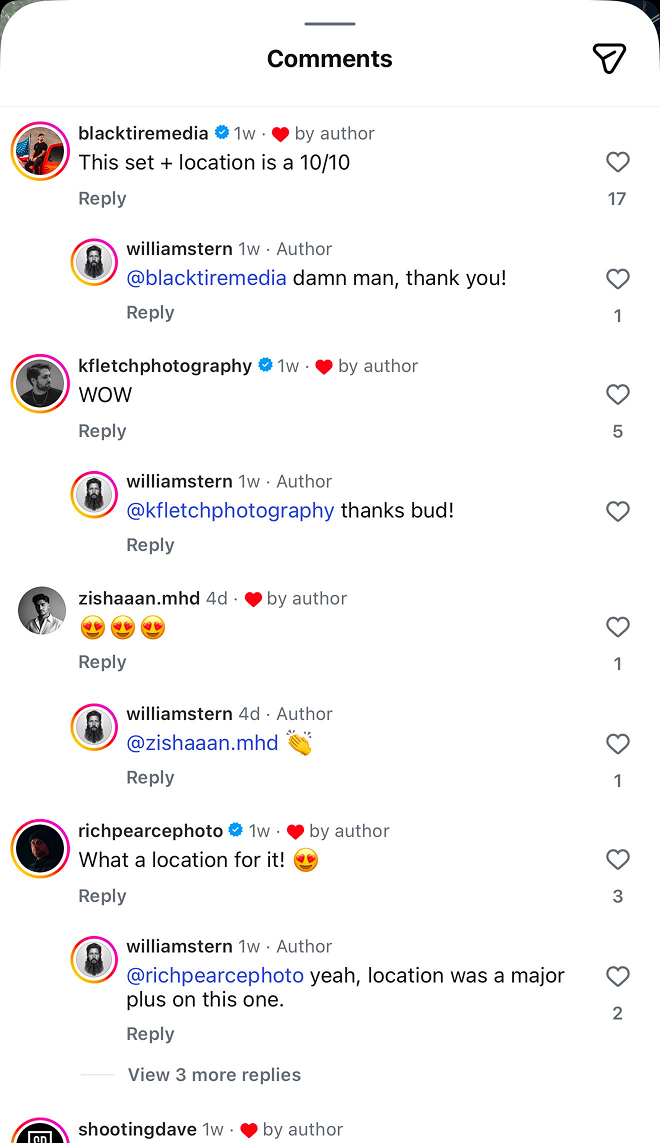
Since 89% of users check comments first, our next iteration would integrate Burst findings directly into the top of the comments section to meet users where they already look.

Platform Expansion
Scaling the extension to TikTok and YouTube to create a universal layer of context across the web.